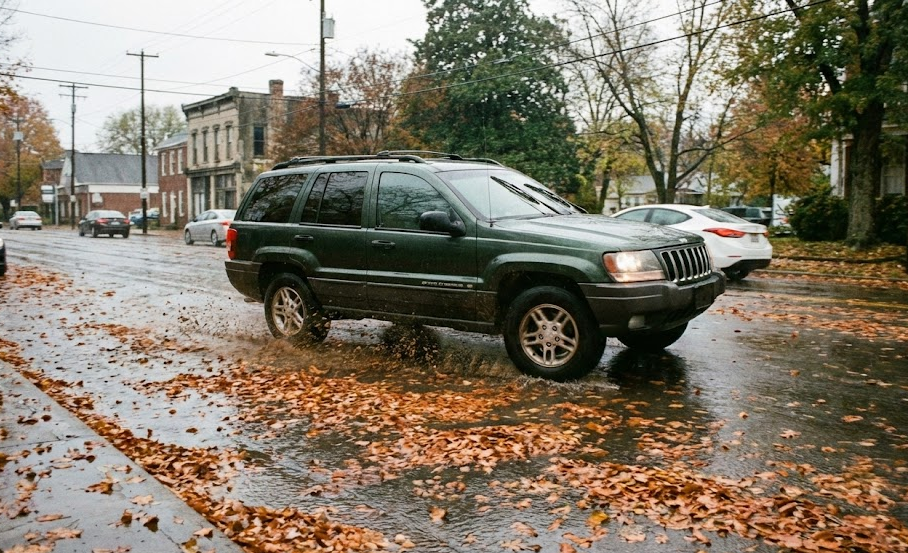
You’re cruising down Murfreesboro Road after a November rain, and suddenly your steering wheel feels disconnected. Your tires are gliding, not gripping. That stomach-dropping sensation? That’s hydroplaning, and in Franklin, it’s not just standing water you need to worry about. When Tennessee’s beautiful fall foliage meets our frequent rainstorms—Franklin averages over 52 inches of rain yearly—those picturesque leaves create a slick, dangerous layer between your tires and the pavement. Even drivers with newer vehicles can find themselves caught off guard when wet organic debris cancels out their traction completely.
Here’s something most Franklin drivers don’t realize until it’s too late: wet leaves are genuinely as slippery as ice. When leaves get compressed under your tires and mix with water, they create a slick paste that essentially eliminates the friction your tires depend on. Wet leaves reduce your tire’s grip by up to 70 percent, putting you in the same danger zone as driving on black ice. This isn’t just a minor inconvenience—it’s a serious safety hazard that affects every turn, every stop, and every lane change.
The problem gets worse on roads like Murfreesboro Road and the back routes through Williamson County, where mature trees drop massive amounts of leaves each fall. While October is often drier, November brings increased rainfall to Franklin. And when you combine the rain with those leaf piles, ordinary roads transform into skating rinks. You might think your tires are in good shape, but even relatively new tread can’t grip through that slippery barrier effectively.
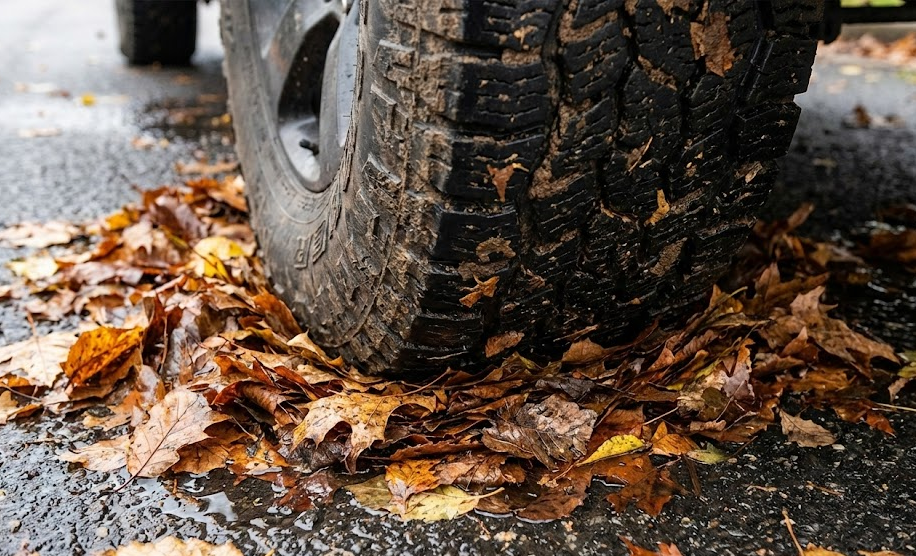
Hydroplaning happens when water builds up faster than your tires can push it away. Your tire tread normally channels water out from under the contact patch, keeping rubber connected to pavement. But wet leaves change everything—they fill those grooves and create an additional barrier your tires can’t penetrate. According to the National Highway Traffic Safety Administration, hydroplaning becomes significantly more likely at speeds above 35 mph, and that threshold drops even lower when organic debris is involved.
When leaves create a mat on the pavement, they trap water underneath and prevent your tire treads from doing their job. The water pressure builds up at the front edge of your tire, and instead of pushing through to pavement, your tire rides up on top of that water layer. At that point, you’re water skiing on four wheels—steering inputs do nothing, brakes become useless, and physics takes over completely. This is especially dangerous on curves or when traffic backs up on Highway 96 near Williamson Medical Center, where you need full control to stop safely.
If you’re driving a newer Jeep Grand Cherokee or Ram 1500 with all the latest safety features, you might feel pretty confident about handling wet conditions. Electronic Stability Control, traction control, anti-lock brakes—these are genuinely impressive technologies. But here’s the hard truth: none of these systems can overcome physics. If your tires don’t have adequate tread depth or your alignment is off, even the most advanced safety technology becomes ineffective because it’s working with compromised information from your wheel sensors.
Electronic Stability Control can only limit wheel spin when your tires have at least some grip to work with. When you’re hydroplaning on wet leaves, there’s literally nothing for the system to grab onto. Your traction control might detect wheel slippage and try to compensate, but it can’t magically create friction where none exists. Lane Keep Assist relies on your tires following your steering inputs, which becomes impossible when you’re gliding on water.
The legal minimum tread depth is 2/32 of an inch, but safety experts strongly recommend replacing tires when they reach 4/32 of an inch, especially for Tennessee’s wet climate. At that depth, your tires still have enough grooves to channel water effectively. Once you get below that threshold, your hydroplaning risk increases dramatically with every mile you drive.
Wet leaves don’t just make roads slippery—they hide other dangers that can seriously damage your vehicle. Franklin’s roads take a beating during fall and winter, with temperature fluctuations creating potholes and cracks. When those imperfections get covered by wet leaves, you can’t see them coming. You might be cruising along a familiar street in the Westhaven neighborhood and suddenly slam into a hidden pothole that jars your entire suspension system, immediately throwing your wheel alignment out of spec, bending your rim, or damaging your tire sidewalls.
Curbs present another hidden danger. When wet leaves pile up along parking lot edges or residential streets, it’s incredibly easy to misjudge where the actual curb sits. Curb impacts can damage your tire sidewalls, bend your wheels, and knock your alignment out completely. Most drivers don’t realize how much damage they’ve done until their tires start wearing unevenly or their vehicle handling deteriorates. Getting a professional inspection after any significant impact can save you from much bigger repair bills and safety hazards down the road.
Your wheel alignment is one of those things that’s easy to ignore until something goes obviously wrong. But here’s what you need to know: proper alignment is absolutely critical for maintaining traction on wet, leaf-covered roads. When your wheels aren’t properly aligned, your tires don’t make full, even contact with the pavement, which means less surface area to disperse water and maintain grip. This dramatically increases your chances of hydroplaning, even if your tires have plenty of tread depth left.
Alignment problems show up in three main measurements: camber, toe, and caster. Camber refers to how tilted your wheel is—if it leans too far in or out, only part of your tire touches the road. Toe measures whether your wheels point slightly inward or outward, and when it’s off, your tires scrub sideways, wearing prematurely and reducing traction. When any of these angles are wrong, your hydroplaning risk goes through the roof.
Alignment issues develop gradually through normal driving. Every pothole you hit, every curb you bump—these take tiny tolls on your suspension geometry. Franklin’s roads, particularly during fall when leaves hide imperfections, are especially tough on alignment. Check your alignment every 12 to 24 months, or immediately after any significant impact. If you’ve noticed uneven tire wear, your steering wheel sitting crooked, or your vehicle drifting slightly, those are clear signs your alignment needs attention before the next rainstorm hits.
Despite your best prevention efforts, you might still find yourself hydroplaning on a leaf-covered Franklin road. When it happens, your instinctive reactions can actually make things worse. Here’s what you should do instead:
Hydroplaning usually only lasts a second or two, though it feels much longer. The key is avoiding panic reactions that make the situation more dangerous. After a hydroplaning incident, slow down significantly, increase your following distance, and consider scheduling an inspection to make sure your tires and alignment are ready to handle Franklin’s challenging conditions.
| Condition | Risk Level | Peak Danger Period | Prevention Strategy |
|---|---|---|---|
| Wet Leaves on Pavement | High | October-November, morning commute | Reduce speed 10-15 mph below normal, increase following distance |
| Hidden Potholes | Moderate-High | After heavy rain, any time leaves cover roads | Avoid leaf piles, watch for depressions, maintain suspension |
| Reduced Tire Traction | High | Any rainfall when tread depth below 4/32″ | Inspect tread depth regularly, replace worn tires promptly |
| Poor Alignment Impact | Moderate | Worsens gradually, critical during wet conditions | Check alignment every 12-24 months or after hitting obstacles |
| Standing Water in Intersections | Very High | During and immediately after heavy rainfall | Slow down before entering, avoid puddles deeper than tire tread |
Q: Why do my tires spin on wet leaves even if I have 4-Wheel Drive?
A: Four-wheel drive helps power go to all four wheels, which is great for getting your vehicle moving in snow or mud. But it doesn’t help you stop or steer any better, and it can’t create traction where none exists. When wet leaves eliminate friction between your tires and the road, 4WD becomes irrelevant because all four wheels are slipping equally. Your tires and their tread depth are what actually determine your grip, so even the most capable 4WD system needs good rubber to work with.
Q: How much tread depth do I need to prevent hydroplaning in Franklin?
A: While Tennessee law allows you to drive on tires worn down to 2/32 of an inch, that’s far too little for safe wet-weather driving. Safety experts recommend replacing your tires when they reach 4/32 of an inch, especially given Franklin’s high annual rainfall of over 52 inches. At 4/32″, your tire grooves still have enough depth to channel water away effectively and maintain road contact. Below that threshold, your hydroplaning risk increases dramatically with every rainstorm.
Q: Can a bad wheel alignment cause my car to hydroplane?
A: Absolutely. When your alignment is off, your tires don’t make full, even contact with the road surface. This means the contact patch—the actual part of your tire touching pavement—is smaller and less effective at dispersing water. Misaligned wheels also cause uneven tire wear, which further reduces your traction on wet roads. Proper alignment ensures maximum tire-to-road contact, giving you the best possible grip when conditions get slippery.
Q: Do new cars with traction control still need tire inspections?
A: Yes, regular tire inspections are essential regardless of your vehicle’s age or technology. Traction control can limit wheel spin when it detects slippage, but it physically requires some level of tire grip to function properly. If your tires are worn down or your alignment is off, traction control can’t overcome basic physics. These advanced systems work best when your tires are in good condition, making regular inspections critical for getting the full safety benefit of your vehicle’s technology.
The best defense against hydroplaning on Franklin’s leaf-covered roads is making sure your vehicle is properly prepared before the next rainstorm hits. At Franklin Chrysler Dodge Jeep Ram Service Center, our factory-trained technicians understand exactly what your Jeep, Ram, Dodge, or Chrysler needs to handle Tennessee’s challenging fall and winter conditions safely. We use genuine Mopar parts and manufacturer-specified procedures to ensure every service meets the highest standards.
Our comprehensive tire and alignment inspection checks everything that matters for wet-weather safety: tread depth on all four tires, tire pressure accuracy, wheel alignment angles, suspension component condition, and overall tire health. We clearly explain what we find and what it means for your safety, so you can make informed decisions about your vehicle’s maintenance.
Click here to schedule your tire and alignment check today and drive with confidence through Franklin’s fall weather.
You can also take advantage of our current service specials to get the maintenance your vehicle needs. Or visit us at Franklin Chrysler Dodge Jeep Ram Service Center at 1124 Murfreesboro Rd B Franklin, TN 37064, where our team is ready to help you stay safe on every Franklin road.